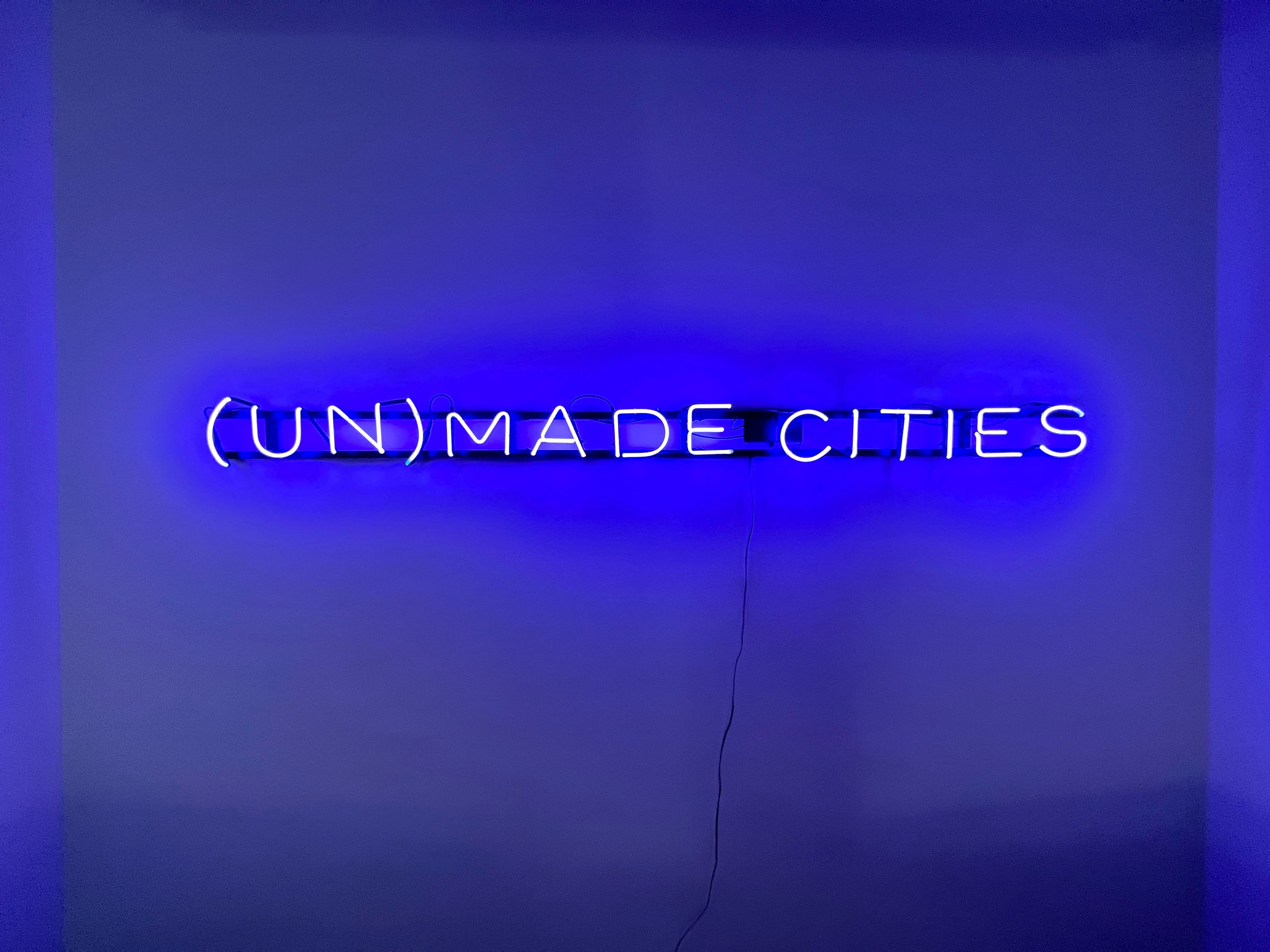
(Un)Made Cities — Cidades (Des)Feitas
Filipe TemtemThis is the 4th edition of the international circulation project of the work “(Un)Made Cities by Segregated Transport Infrastructures”, funded by the Ministry of Culture, Arts and Heritage of the Chilean Government, through FONDART 2022.
The exhibition displays an urban project developed for the Costanera sector, in the Ribera Norte of the city of Concepción (Chile), characterized by strong socio-spatial segregation, produced by the Ribera Norte Train – which since 1873 has prevented the city's connection with the Bio Bio River – and a series of highways, which ended up tripling this barrier/border effect, favoring the fragmentation of the territory and the occurrence of several informal settlements that expanded after the earthquakes in Chillan and Valdivia, consolidating what is now known as the Aurora neighborhood of Chile: a fragmented city, where the urban fabric and life have been and continue to be deteriorated and marginalized by segregated transport infrastructures.
With the aim of (re)making this city, the exhibition presents a possibility for urban intervention that restores its dignity and sense of belonging, structuring its basic needs and services. In this case, through a viaduct-building, approximately 1.5 kilometers long, whose modular plan is structured through a box girder, allowing the construction of 43 inhabited modules (130 m2 / 10 x 10m) where multiple services and programs are located. This inhabited infrastructure eliminates the physical presence of the train at ground level, replacing it with an active facade that participates in the morphological (re)configuration of the adjacent context. In this way, a contemporary vision in the field of infrastructure architecture is presented, a new railway prototype that activates a kind of tactical urbanism, where the railway, in addition to serving as an axis of mobility and public transport, functions as a service cluster, carrying goods and services for this vulnerable sector of the capital: A retroactive infrastructure that allows simultaneous investment in architecture, infrastructure and public space, maximizing the economic and social efficiency of the project.
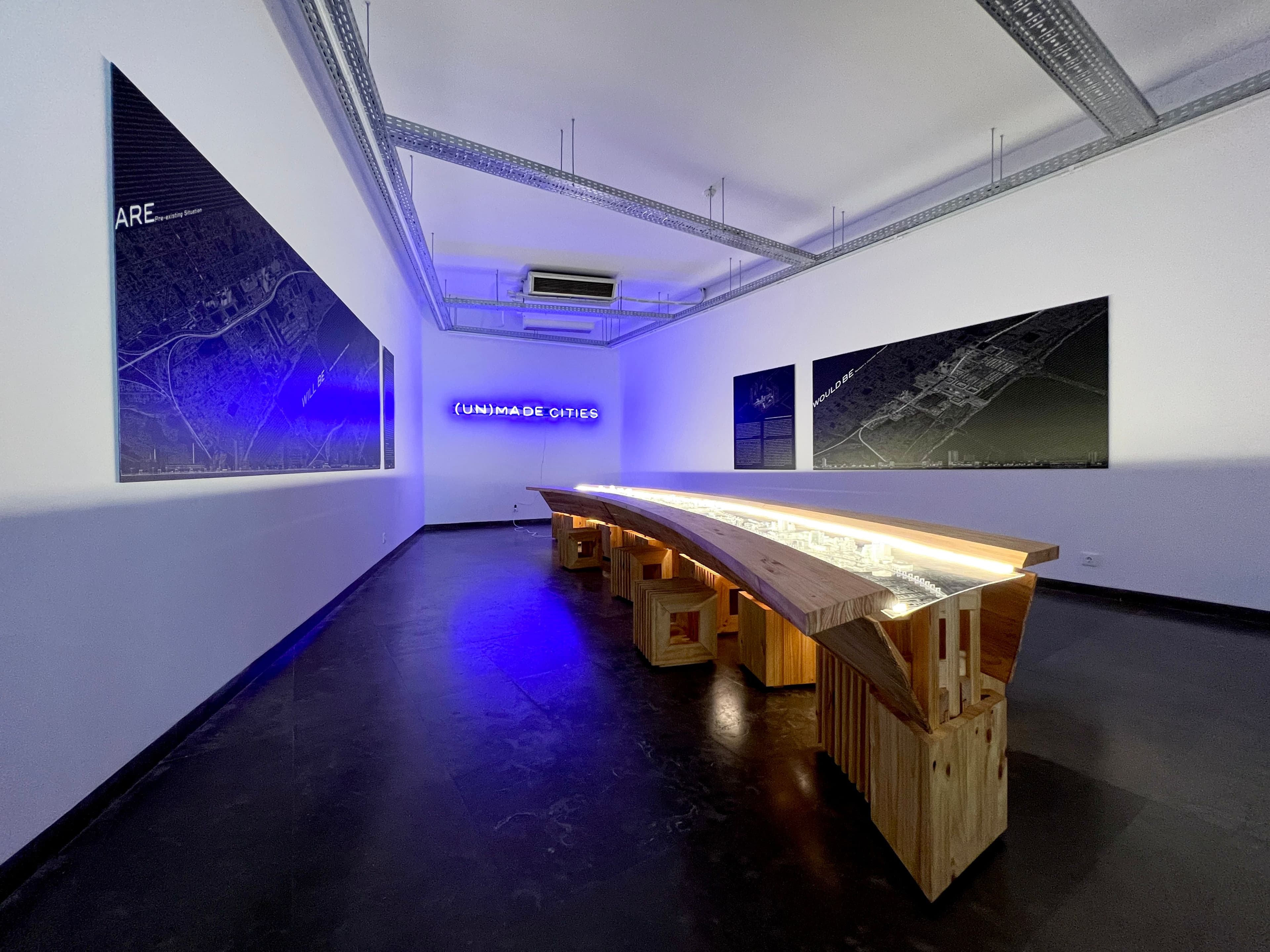
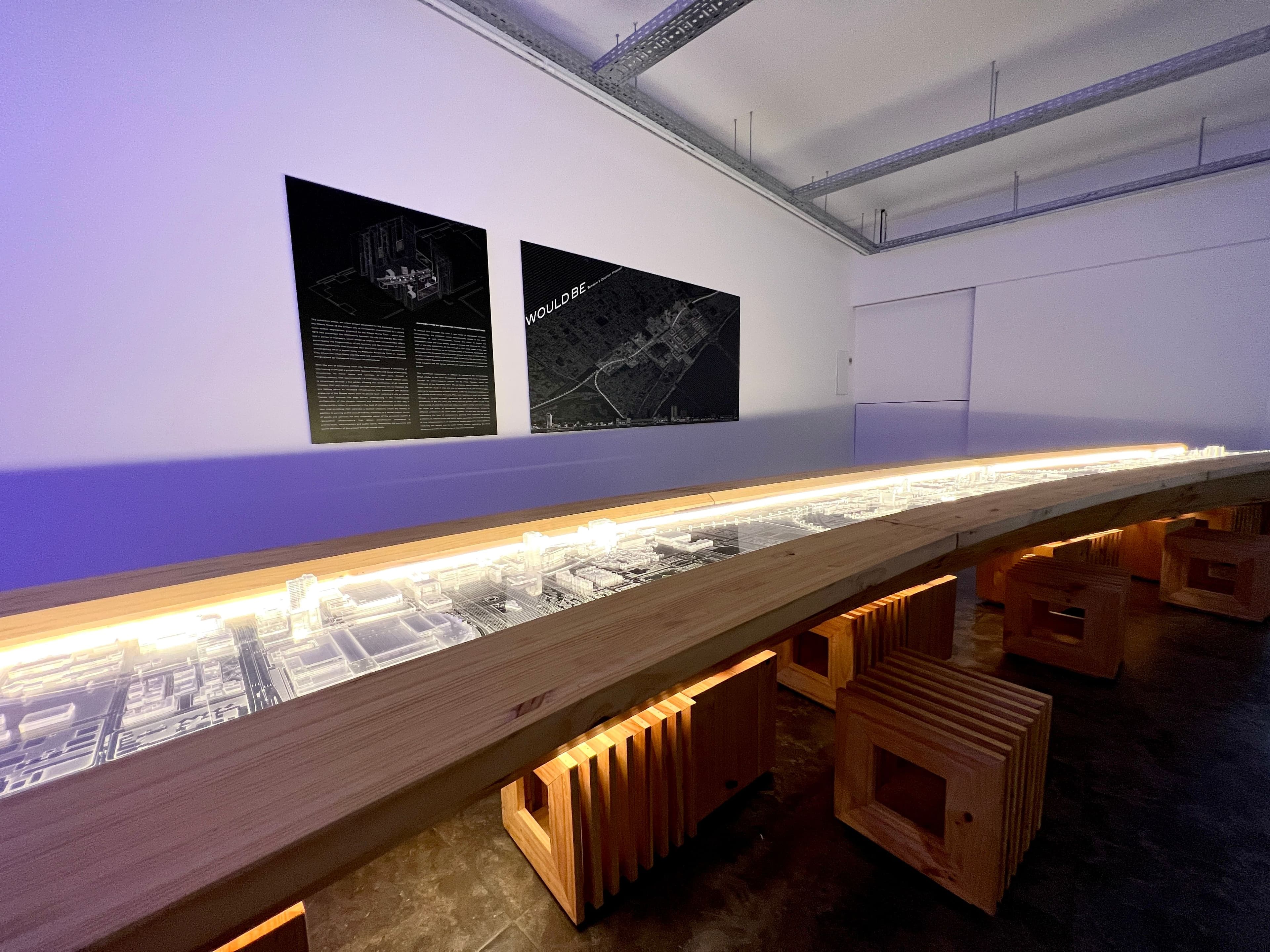
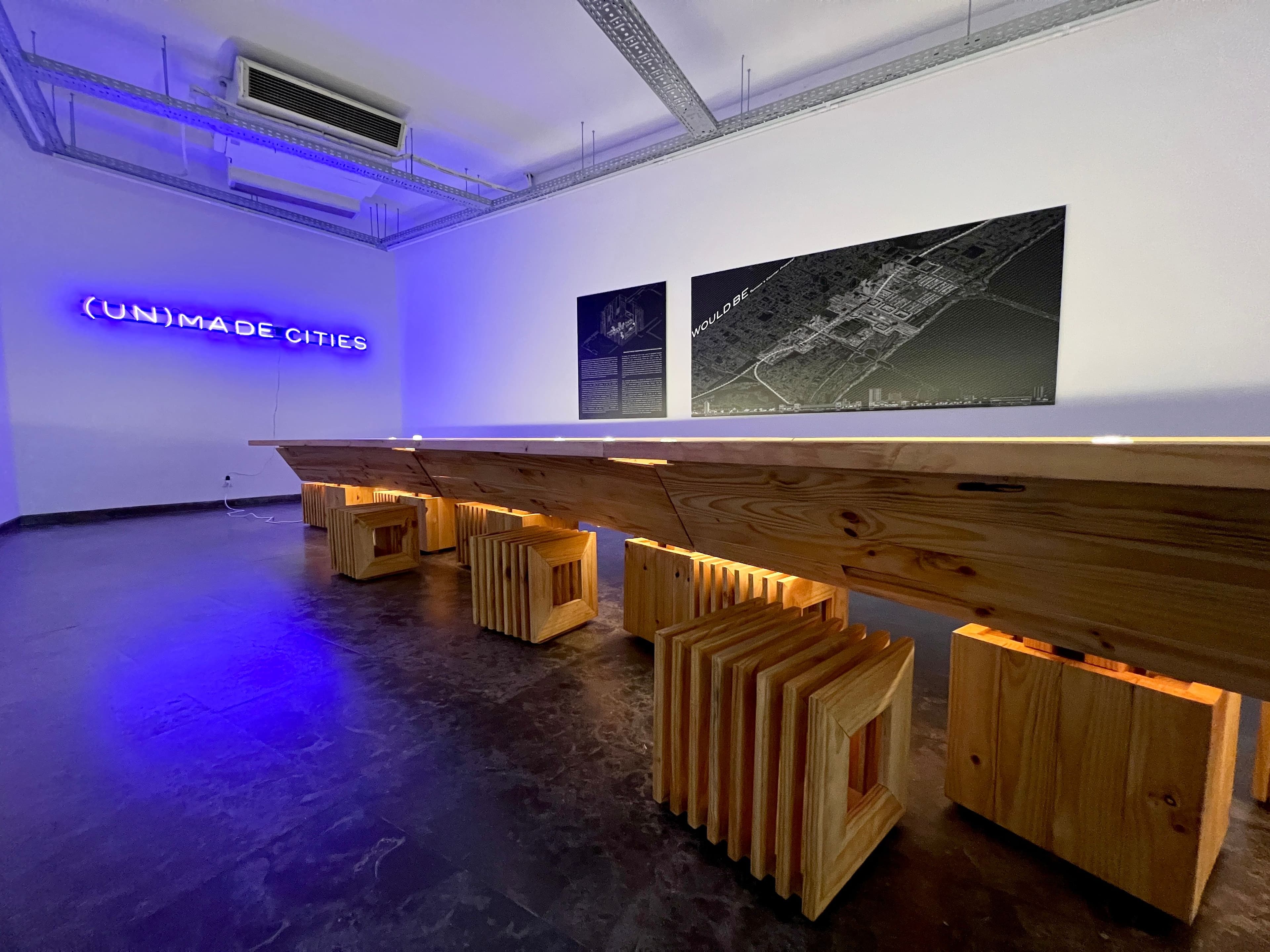
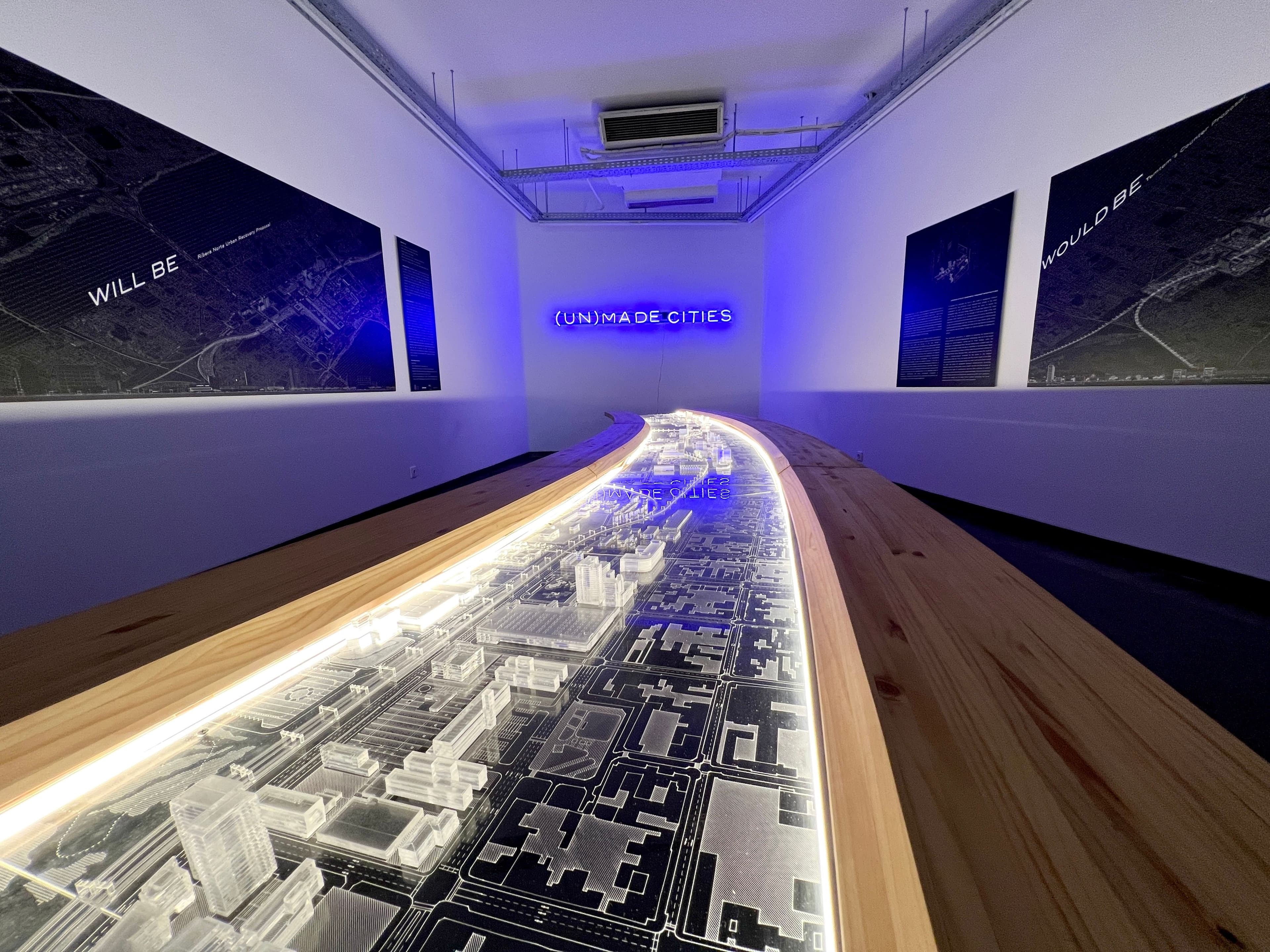
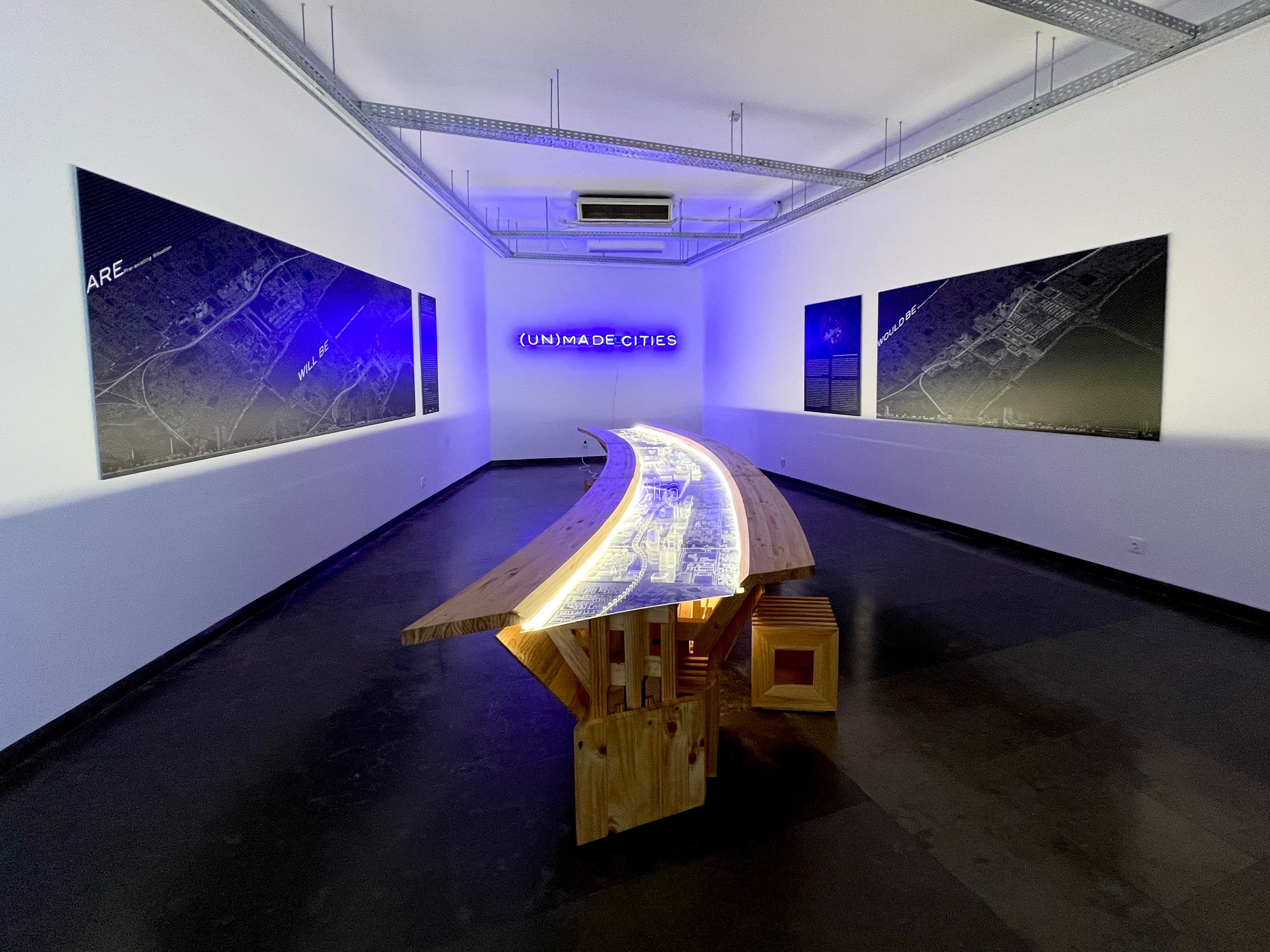
To showcase this (re)constructed city based on a new railway prototype, the exhibition circuit metaphorically alludes to the urban implementation of these infrastructures, forcing the visitor to circumvent the segregated track to access and observe the "other side of the city" (the exhibition). This is achieved through a 1:20 scale model of the viaduct-building that functions as an exhibition table, facilitating observation and discussion of the urban project printed on the table at a 1:1000 scale. In this way, the box girder becomes a tabletop, while the server modules are designed as fixed supports and the served modules are used as benches for observing the project.
This centrifugal organization, in addition to recreating the barrier/border effect, alludes to the spiral model that allowed this project to be developed through action research conducted by Filipe Temtem, within the context of the Elemental UC Chair. We are talking about a project cycle that began with a study of what the city is, according to its pre-existing logics, moving on to an understanding of what it will be, according to the governmental ambitions proposed by the Ribera Norte Urban Recovery Plan, until arriving at what it could be through a counter-proposal presented by Filipe Temtem to the Bio Bio regional government. Along this path, the panels and the printed model on the table show what this city is, what it will be, and what it would be under the influence of segregated transport infrastructure, comparing different solutions to the same urban problem. All this with the purpose of questioning contemporary urbanism that continues to design architecture, public space, and infrastructure separately, opting to bury the latter: an alternative 40% more expensive, which renders the subsoil and groundwater unusable, restricting the travel experience and the contemplation of the urban landscape.
Credits:
Project Author: Felipe Temtem
Curator and Content Director: Filipe Temtem
Exhibition Design: Filipe Temtem
Graphic Proposal: Filipe Temtem, Daniel Saenz, and Diego Simeone
Model of the viaduct-building (table), scale 1:20: Igor Fracalossi
Urban Model (tabletop), scale 1:1000: Diego Simeone, Carlos Soza, and Renata Grob
Organization: Elemental Chair, Pontifical Catholic University of Chile
Sponsorship: ELEMENTAL S.A. / FADEU, Pontifical Catholic University of Chile / CENAMAD: National Center of Excellence for the Timber Industry / FONDART 2022 (National Fund for Cultural and Arts Development), Ministry of Culture, Arts and Heritage, Government of Chile / FIOA (Fund for the Internationalization of Artistic Works), Department of Arts and Culture, Vice-President of Research, Pontifical Catholic University of Chile
Filipe Temtem is an architect, graduated from the Faculty of Architecture of the University of Lisbon (2008). He holds a Master's degree in Theory and Practice of Architectural Projects from ETSAB, Polytechnic University of Catalonia (2012). He has a PhD in Architecture and Urban Studies from FADEU, Pontifical Catholic University of Chile (2021). Currently, he is a member of OASRS and co-founder of the FTTA Architecture & Design studio, recently recognized with the Abertis Chile 2021 Award and the Inclusion Award 2022 at the New York Architecture Biennial. He is a professor at the Faculty of Architecture of the Pontifical Catholic University of Chile, and is part of the UC City and Mobility Laboratory and the Elemental Chair, co-directed by the 2016 Pritzker Prize winner, Alejandro Aravena. He served as department director at the A Nossa Casa Cooperative, notably working at the PR Arquitectura Global studio, where he won the National Architecture and Public Space Competition of the António Manuel Sardinha Foundation (2010). In the academic field, he was part of the International Research Group of Architecture & Society (GIRAS) at ETSA Barcelona and was a visiting professor at the Technische Universität Berlin. In 2021, he received the Doctoral Excellence Award from the Pontifical Catholic University of Chile, and has been recognized in national and international competitions with awards for Best Publication of Disciplinary Relevance DIRIP Chile in 2021, 2017 and 2016, and the Best Paper award SIIU XII Lisbon/São Paulo 2020.