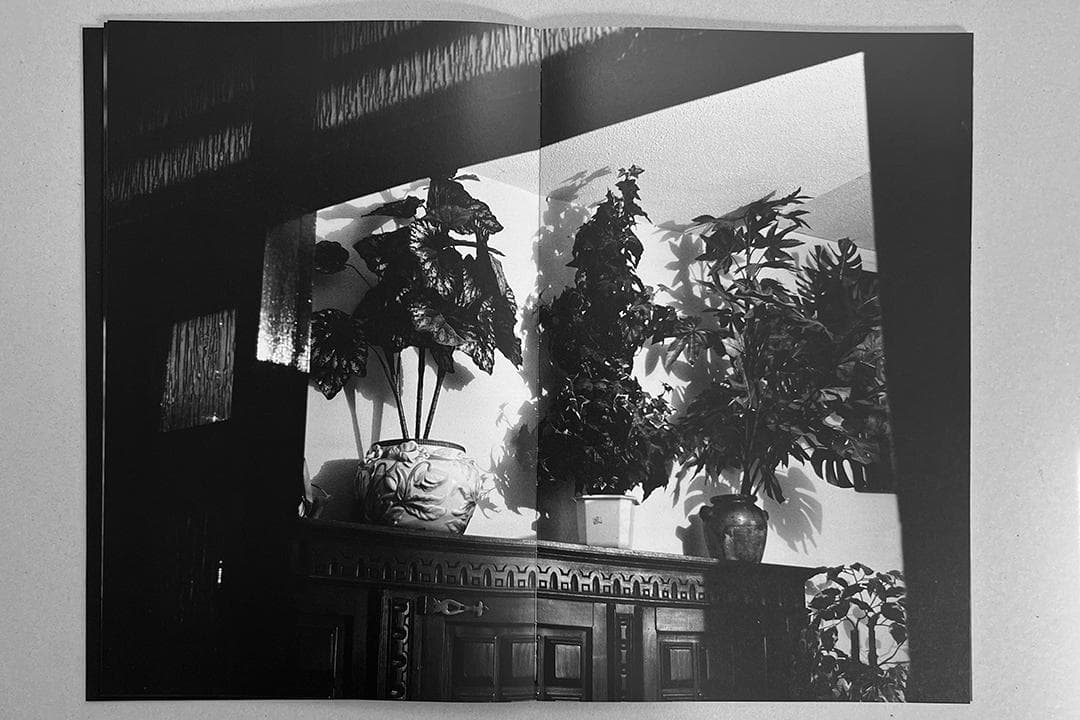
Rien
André CepedaThe most striking aspect of the images that make up André Cepeda's Rien series is their direct, categorical, and raw literalness. A stone suspended in black, a wall marked by time and mistreatment, an electrical wire piercing a ceiling, a naked woman exposing herself—these are exactly that. The central expression here is "that's exactly it."
What is in the images can be described with a scalpel, analyzed as if in a laboratory glass, felt like a snap, but always under the aegis of an imperious feeling that what is here is exactly that: a woman or a wall, a stone or an electrical wire.
The path to arrive here had passed through several stages, from surgical attention to urban remnants, a frontal gaze upon what deserves nothing more than a fleeting glance. Then a close coexistence with lives that, too, could only be seen in passing.
The series Rien, however, in its conversion to black and white, gained a reality that only photography can confer, especially because it did not become entangled in any poetic rhetoric about the power of black and white itself, nor did it get lost in the creation of a more or less allegorical discourse. Its literalness is its argument, opening up a multiplicity of possibilities, often disappointing for analysis – there is no discourse that can seriously convert the image into a metaphor for anything, neither sadness, nor abandonment, nor scars, nor anything else.
(...) Sometimes, when we look at these photographs, we are confronted with some memory of the cinema of Pedro Costa, or Jean-Marie Straub. Because the images are of an equivalent formal rigor and because they cross before us, without mercy. But unlike cinema, in which the cinematographic apparatus is always present – and voluntarily present, in the cases cited – in these photographs the photographic apparatus has disappeared, it has become translucent. We don't think that between us and what is before us there is a process and a photographer because the exhibition of those bodies and those walls, those places and that sex, was made to be there, pointing to us as its recipients, without mediation, directly tangible, as available as anything that has always been there, exposed, sometimes as discreet as a small crack in a wall, a droplet, a fold in the skin of a dried fruit, the sweetness of a stone. As if between us and this world there breathed a breath that can be felt. As if between us and the images nothing existed.
(excerpts from the text Nothing by Delfim Sardo)