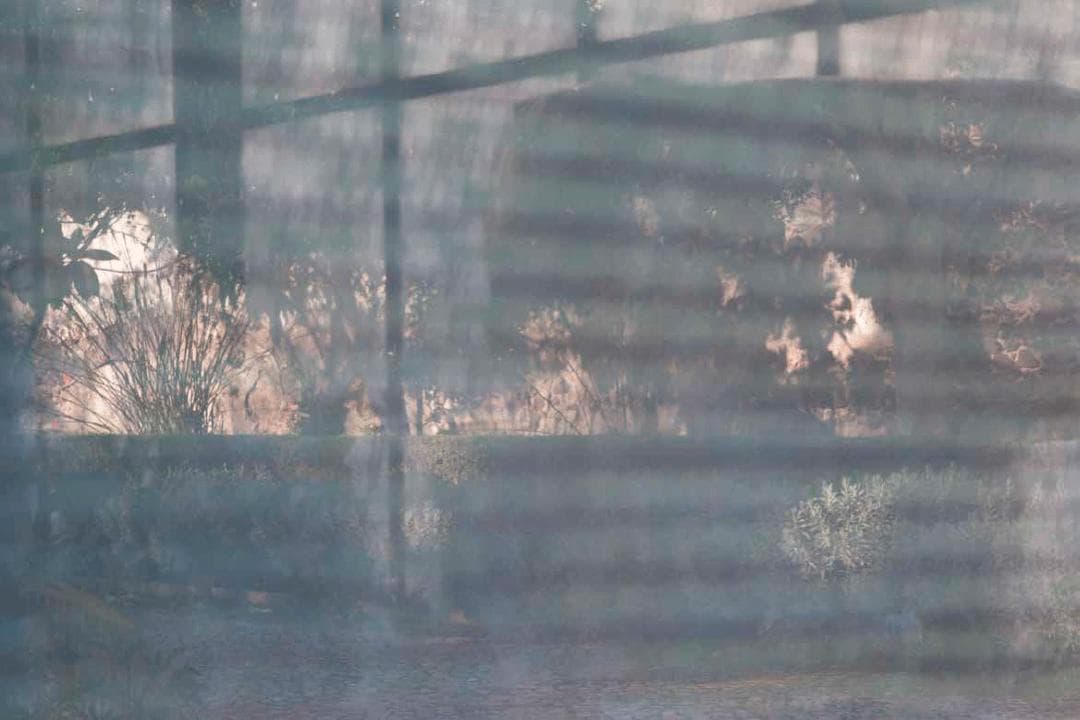
Urupë
Carina MartinsAlthough mechanical reproductions of the world are fixed onto emulsion paper, this does not mean that the images are indefinitely imprisoned by matter. A canonical narrative would say that the Western white man needed to touch the images to mediate the connection between the eye and the spirit, and through this gesture to elicit the primacy of perception. It would also say that photography has pursued this same genealogy of representation by duplicating images directed at the tactile gaze, thus abandoning the fascination felt by the painter at the moment he is pierced by the universe.
In other latitudes, the sacred relationship with nature is a striking component of the experience of indigenous peoples, and it is from this bond that visions, respect, and profound wisdom about the forest as a transcendent organism emerge. On the one hand, it is known how Ayahuasca rituals (Peru) favor the transmigration of forest spirits, as well as their visualization by shamans, through the incorporation of a spirit-image. In this context, the word "spirit" has no connotation with the Catholic religion; it simply means the vital principle that animates all living species, their vital force. In the words of the Peruvian artist Pablo Ameringo, "a plant may not speak, but it contains a spirit that is conscious, that sees everything, that is its soul, its essence, that makes it alive" (Narby, 2004:95).
Jeremy Narby, an anthropologist who lived and studied for decades with ayahuasca users, proposed as an explanatory hypothesis for this relationship—between the human mind and the natural environment—the existence of a biocommunication process between the DNA of human and plant cells. In short, Narby concluded that the shaman, by ingesting cells of a hallucinogenic plant, would make his neuro-receptors in the visual cortex sensitive to biophotonic emission (photons of cellular origin), thus producing a kind of forest television or biospheric television.
In a contrasting conception of image, the Yanomami Indians disregard our modes of relating to the light emanating from things. In the specific context of this indigenous culture of the Amazon (Brazil), materialized images do not exist, and whenever access to the presence of the “real” is sought, images are brought down onto the body of the shaman. It is through the incorporation of an “audiovisual device,” dispersed in nature, that the descent into the social body of the infinite-virtual being of things is effected. And, if for the Yanomami everything is image, it is because everything radiates energy (gradients of power). Urupë is the name given to this process of image production, resulting from the choreography of transfigured bodies and the fluidity of figurations that escape our idea of representation.
When contemplating Carina Martins' photographic series Urupë, we can foresee that it is permeated by a vision and an aesthetic that we propose to approximate to a, let's say, universal meaning of Urupë, translated into a certain ontological experience of nature or of what Spinoza and Coleridge described as natura naturans: nature as a sentient being and autopoietic organism. It is also close to a synthesis given by the literary experience of Deep Ecology, in the pages of American naturalists such as Ralph Waldo Emerson or Henry David Thoreau, or absolutely experienced in the philosophy of nature of Aldo Leopold and Arne Naess.
On the other hand, in a patrimonial lineage of the imagistic tools of (re)production of the experience of presence, where we speculatively integrate this set of photographs, we would undoubtedly place a significant part of the work of the filmmaker Andrei Tarkovsky. In one of his masterpieces, Stalker, it becomes evident that the Zone, as a landscape with a life of its own, occupies most of the filmic space, thus being a hyperesthetic and constantly mutating place. In Tarkovsky, the human world is obsessively correlated with the four elements of nature. Nature communicates and intercedes with humans; it is therefore a poetic metaphor for emotions and an icon of a paradoxical hypersensitivity.
The visual complexity of this series is not limited to the kaleidoscopic interplay between the supposed referent – the flora residing in some botanical garden – and the textures that give body to a diaphanous or phantasmagorical mantle, a kind of reticulated veil through which the entire visual plane is concealed. To this translucent membrane is added another architectural structure, composed of window frames, which disguises itself in a matrix that seems to frame the vegetal universe of an inaccessible nature.
What we see in these images is essentially a layered composition of visual elements, a stratigraphy composed of spots, reflections, and perpendicular lines in constant interaction. In some of the photographs, the vibratory tension that emerges from them is more intensely noticeable, producing in these cases a modulation of visual perception that we would classify as hallucinatory.