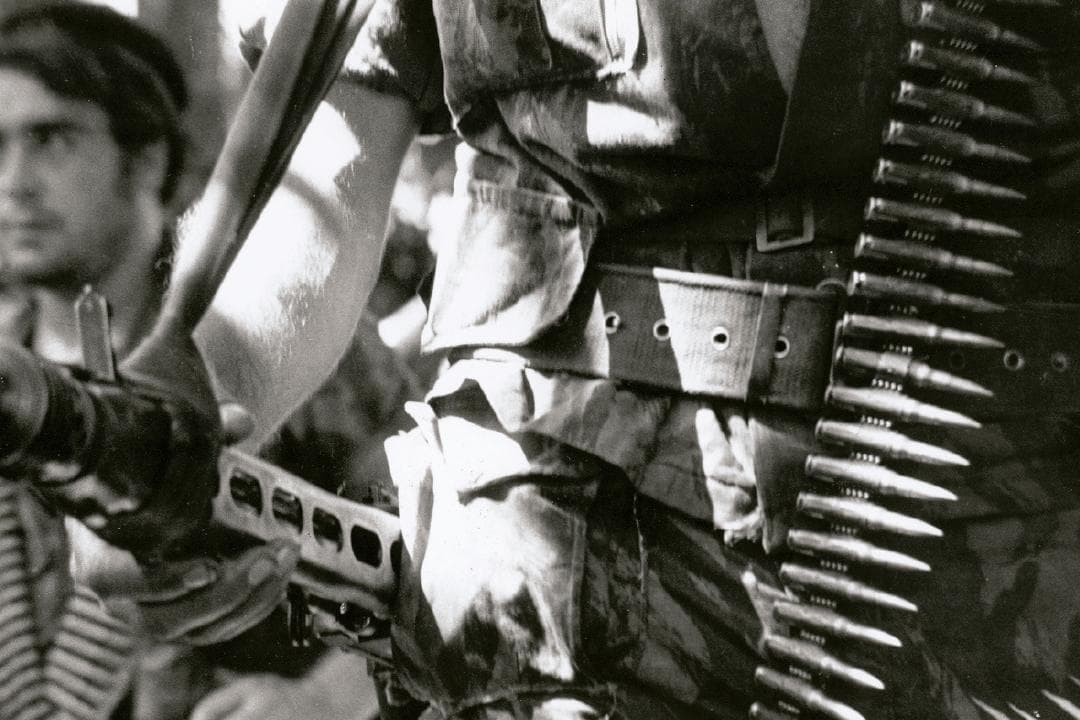
Memórias de Guerra
Fernando FarinhaI went to Angola in 1955 with my mother and father, an army officer then stationed in that colony. In 1961, at the age of 19, the assault on the Luanda prisons, unleashed by the MPLA, caught me by surprise while I was on vacation in that capital, after starting a course I was taking at the Tchivinguiro School of Agricultural Regents. Invited by the newspaper O Comércio to "help" the editorial staff during the holidays, those short days would end up turning into thirteen years of war, which I reported on almost daily!
I started by being stationed at the airport where I listened to the wounded and traumatized who arrived evacuated from the critical regions of the North due to the outbreak of terrorism; Because initially, terrorism was associated with the massive massacre of dozens and dozens of settlers, women and children, black and white, by the UPA, surprised on coffee farms in the fateful early morning of March 15, 1961.
To try to better understand what was happening, I decided to try to reach the sites of the tragic events. I traveled to Caxito, a small border town between peace and war. There, the 1st Cavalry Squadron "Dragons" was stationed, with the mission of protecting the Mabubas dam and escorting convoys of civilian vehicles traveling north. The "Dragons" also supported, with their ETT and Panhard tanks, the grid troops, that is, the troops positioned on the ground to provide security with their patrols to all the workers in that region.
My primary concern was to be able to provide a photographic view and convey in words to all readers the behavior of the soldiers in combat zones. And believe me, I saw, heard, and learned a great deal during those intense days spent alongside such valiant men; and, despite the difficulties with censorship and sending these reports, I always achieved my goals. Of course, I respected the rules, such as not revealing the names of the soldiers and their ranks, their locations, the number of wounded and dead. Our lives could be in danger.
Getting the reels and texts to their destination also required a lot of imagination! Because the media didn't have the technology we have today: I even sent reels of notes taped to the bandages and splints of the wounded being evacuated to Luanda.
Because of my conduct and the regularity with which the magazine Notícia, the media outlet where I had started working, published the reports, I managed to win the sympathy of the military, who welcomed me as if I were another member of the "family" and even gave me all the necessary protection. I also aroused the curiosity and attention of the guerrillas who were attentive to my reports. The proof was the numerous messages detected requesting the publication of the magazine "Notícia".
And I, who actively participated in the thirteen years of war, who contacted many, many combatants in the theater of operations, began to perceive the enormous erosion that time caused in the minds of these men. Indeed, in 1961-1962 there was a very strong sense of unity and a single homeland, but this strong sense of unity was lost. It was the erosion of a long war leaving deep marks and scars.