K + Uunniivveerrssee
André Sierk. + uunniivveerrssee brings together selections from André Sier's k. and uunniivveerrssee series. Dynamic computational environments, fixed in installations, prints, and sculptures. Environments that explore the generation of infinite navigable virtual spaces and propose multimodal models of the creation of the universe. In these series, all pieces are generated through algorithms that run on the computer and produce interactions, objects, and prints.
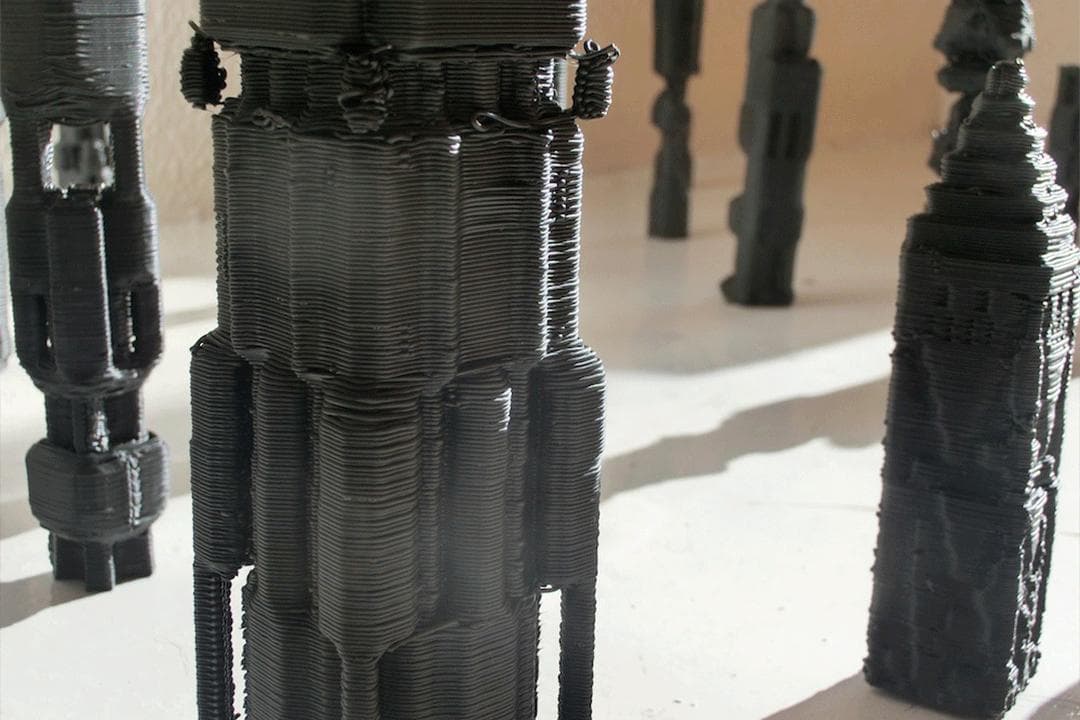
"The k. series has been developed across various media since 2007, based on Franz Kafka's novel The Castle (1926), in which the protagonist is K., a surveyor mistakenly hired by the authorities of Count West-West. The series began with the playable environment k. (2007) and consists of its derivatives: the installation k.~ (2010), the installation k.castle (2010-11), and the results of this process – the .tga prints of screen stills (2009) and the .stl topographic sculptures (2010-11). To create k., Sier programmed a source code with 5021 lines of Java code. Navigation allows the user to enter 4,294,967,295 distinct spaces – where only one contains Count West-West's castle. Through various conversations with the villagers, the user changes from..." level, having access to new territories where buildings, spirals, voids and squares are algorithmically generated."
from The Naming of the Artwork: k. by André Sier, text by BYPASS for the exhibition k.@ appleton square 2011
[...] some notions to be taken into account when we see, hear, feel, perceive and interact with any of the pieces that are part of “uunniivveerrssee.net”: 1) the perception environment is multi-modal: space, object, sound, image, interaction, feedback, ghost, connection, network, sharing, suspension, interval, continuation, potential. 2) “uunniivveerrssee.net” is not a finite world, but a cosmogony of possibilities, computationally generated on digital bases with various extensions (32-bits and 64-bits). In this case, the phrases “I went to see André’s exhibition” or “I liked Sier’s installations” are incomplete and describe only the memory of a very incomplete and minimally lasting perception of the potential reality inscribed in the offered works of art, whose apprehension actually requires the seemingly infinite time of games. 3) The creatures printed and removed from the digital world of possibilities inscribed or triggered by human-machine interaction—a game, individual or collective, random or constructed, shared or simply cumulative of possibilities—are the perceptive, sensory, and physical proof of a real emergence, much closer to home than the merely fictional or simply virtual universes of the prehistory of generative and cognitive art in general.
(from *Coisa mental, “seeds rather than forests”*, text by António Cerveira Pinto in the exhibition catalog uunniivveerrssee.net @ Museu de São Roque, Lisbon, 2011)