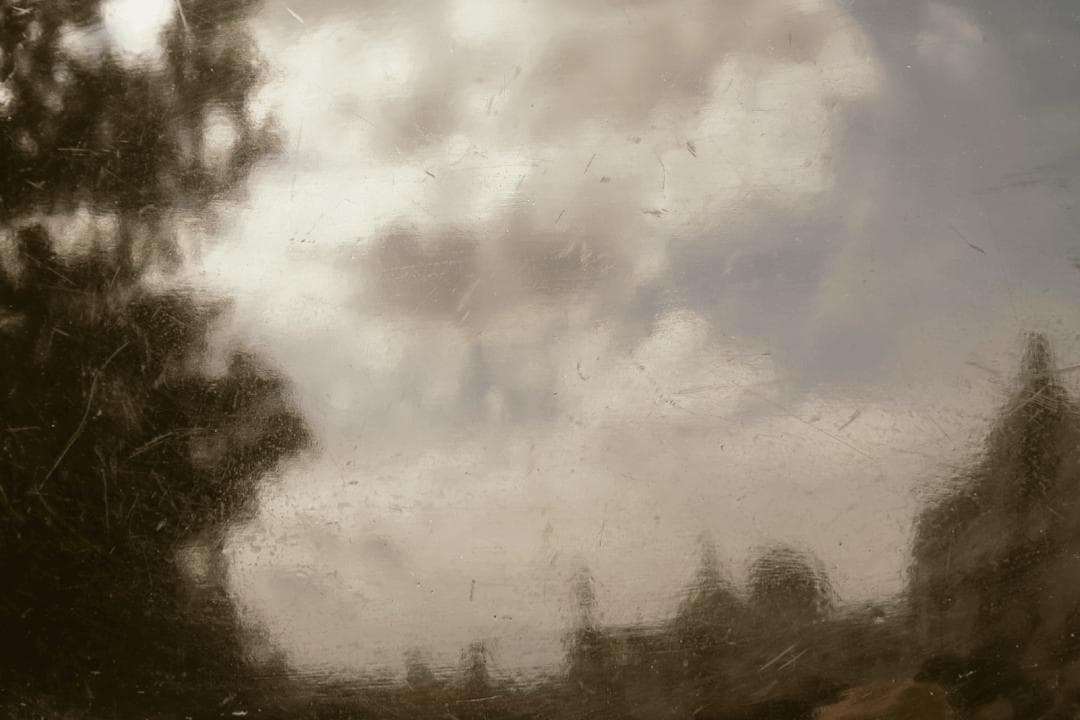
Espelho Negro
Rita MagalhãesThe source of pure vision. Rita Magalhães' photography has, since its inception almost two decades ago, been permeated by an intense, boundless desire for painting. As if the artist understood that, from the very beginning, the memory of painting as a tradition of producing images has inevitably inhabited photography as a primitive scene. And as if, through the latter, she constantly sought to return to that first, foundational, original, and originating scene.
In this sense, one could affirm that Rita's gaze is like that of Ulysses. It is a gaze that incessantly returns there, and to itself, as if this were the true source of all vision that was, is, and will be. Seeking to recognize what was only glimpsed, perhaps only once, or what was merely imagined and dreamed of seeing. Which opens up the field of what one wished to see. (…)
Thus, the artist's gaze travels through the world, seeing around her, curious like a child seeking in each thing its most secret sign, the door that slowly opens, the discreet warning that something is approaching and can be seen in the distance, at once tender and violent, like the half-opening of eyelids after a dream, but still before waking. But something that can never be captured, because if captured, it would also be lost forever.
A gaze entirely born in silence, as is always expected of the gaze proper to contemplation, at once distracted and attentive, curious and indifferent, interior and exterior, a very thin film between the two. What it captures, then, is not things as we see them, nor the images of things that awaken us to them, but instead the before and after they already are, or have been. What remains in between and surprises them on the path of being. (…)
Such a gaze restores to things their mystery, not wanting them drawn and clear, or abstract, but rather full of symbolism and distance, operating as agents of metamorphosis. It transfigures. That is why the cities he sees have distances, lights, golden dust, a mist that dissolves the contours of things like the humidity rising from the sea or the river, and which seems to transfigure them as if under the vague light of some apparition. The cities merge, hallucinatory, almost liquefying, their characters are liquid and traverse them as if losing within them the form of wholeness. And the light itself is a cloak that spreads beneath the gaze. There are no contours but colors, stains, muffled reverberations of light and atmosphere under an enigmatic prism. (…)
After the series she dedicated to Vermeer or Caravaggio, Ingres or Delacroix, it is not surprising now that the artist wants to delve into those symbolist abysses to which her dreamy temperament calls her, as a painter who paints with photography. (…)
And in the age of photography, Rita Magalhães paints with her photographs without seeing any problem in this, quite the contrary, since on a more intimate plane, that of the image, nothing differentiates painting from photography, rather one echoes the other.
Because painting is born from this will, this desire to fix not things or their image but only the impression of things and the world, of beings and atmospheres, the way they affect the gaze. (…)