Endless Conveyor
Inês RaposoEndless conveyor refers to the human possibility of revisiting, through memories, places, thoughts, events, or emotions. Creating a cyclical poetics where narratives with biographical and political reminiscences develop.
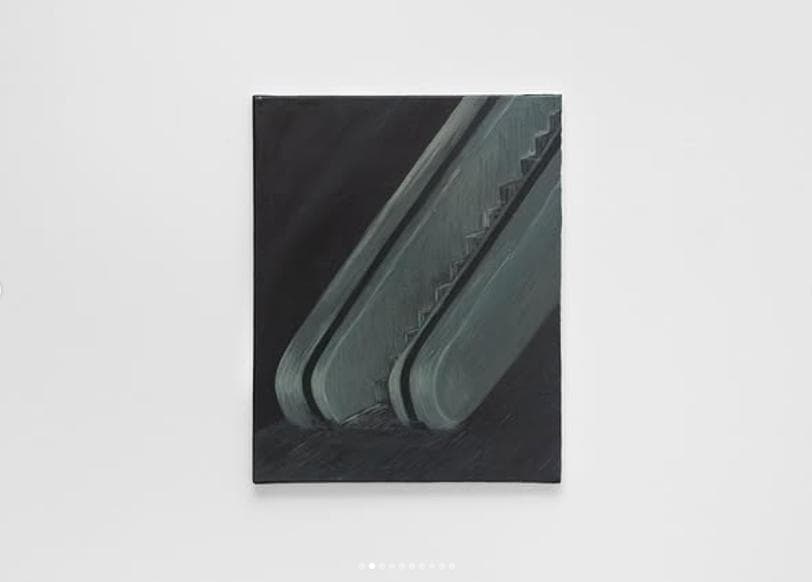
The exhibition begins with a painting of an escalator (“endless conveyor”, 2024) that I made after reading Things I Don’t Want to Know. The first part of Levy's trilogy (Things I Don’t Want to Know) is an autobiographical work, about gender politics and philosophy, that emerges as a response to George Orwell's famous essay Why I Write. In this work, Levy focuses on the need to write, relating it to her life story and her career as a writer as a woman.
The object “escalators” appears in the first three pages of Levy's book as an object that transports the narrator to an emotional space.
“It was as if the moment of the escalator carrying me forward and upward was a physical expression of a conversation I was having with myself.” Escalators, which in the early days of their invention were known as ‘traveling ladder houses’ or ‘magic walkways,’ had mysterious zones that became dangerous.”
“If escalators had become machines with torrid emotionality (…).”
And on the last two pages of the book:
“I had told the Chinese shopkeeper that to become a writer I had to learn to interrupt, to speak up, to speak a little louder, and then louder, and then to speak in my own voice, which is not loud at all. My expedition with him had taken me to places I did not want to visit. I had not expected to return from Africa while sheltering from a snowstorm in Majorca. Then, as my friend left, Africa was not Africa when I found myself back in London. Escalators’ stairs, he patented in 1859 and then redrawn by engineer Jesse Reno, were first described to the modern world as an ‘endless conveyor.’”
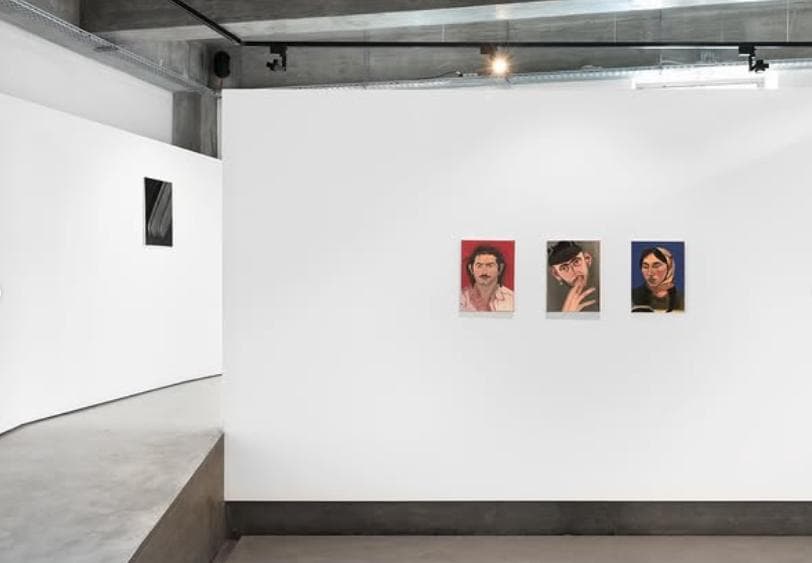
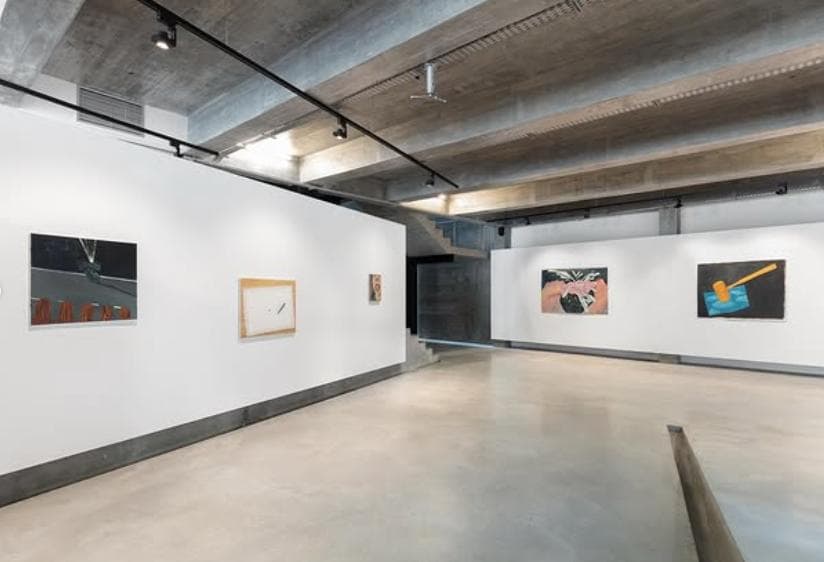
The design of this painting exhibition takes as its starting point the idea of temporal displacement that the escalator represents for Deborah Levy. In selecting these paintings, I thought about the small displacements of daily life I've experienced in the last three years, such as Levy's assertion that beaded bracelets made for children were made by fictionalized children's faces.
Influenced by images from my daily life that seemed like a fairy tale, or even the planet Kitchen Weapons (2023) that I built during long nights in 2019, or the large potatoes in Chantal Akerman's film Jeanne Dielman, 23, quai du Commerce, 1080 Bruxeles, or Botticelli's Venus (1480) playing ball on a football field, I worked in this exhibition with the political and philosophical question of the need to create.
Inês Raposo (Pragal, 1995) is a visual artist.
She graduated in Painting from the Faculty of Fine Arts in Lisbon. She lives and works in Lisbon.
She has participated in several exhibitions, including:
Cat/Rat at Safra. Lisbon (2024)
Be my Guest at Galeria Nave. Lisbon (2024)
9th edition of Casa da Dona Laura. Lisbon (2024)
Blind Taste at Arbag — organized by artists Pedro Matos and Ricardo Passaporte. Lisbon (2024)
You Don't Invite 13 to Dinner at Dialogue Gallery. Lisbon (2023)
Study of the Environment (+18) organized by Purga (Isabel Cordovil and Rudi Brito) at Carpintarias de São Lázaro. Lisbon (2023)
Something Moved in the Womb. Lisbon (2022)
More Edges at Mato. Lisbon (2020)
Confidências by Pousio Arte e Cultura (2020)
Jet Lag at Galeria Liminare, Lisbon (2019)
Résvés at Casa do Sal, Castro Marim (2019)
Mãos at Oslo National Academy of the Arts, Norway (2017)