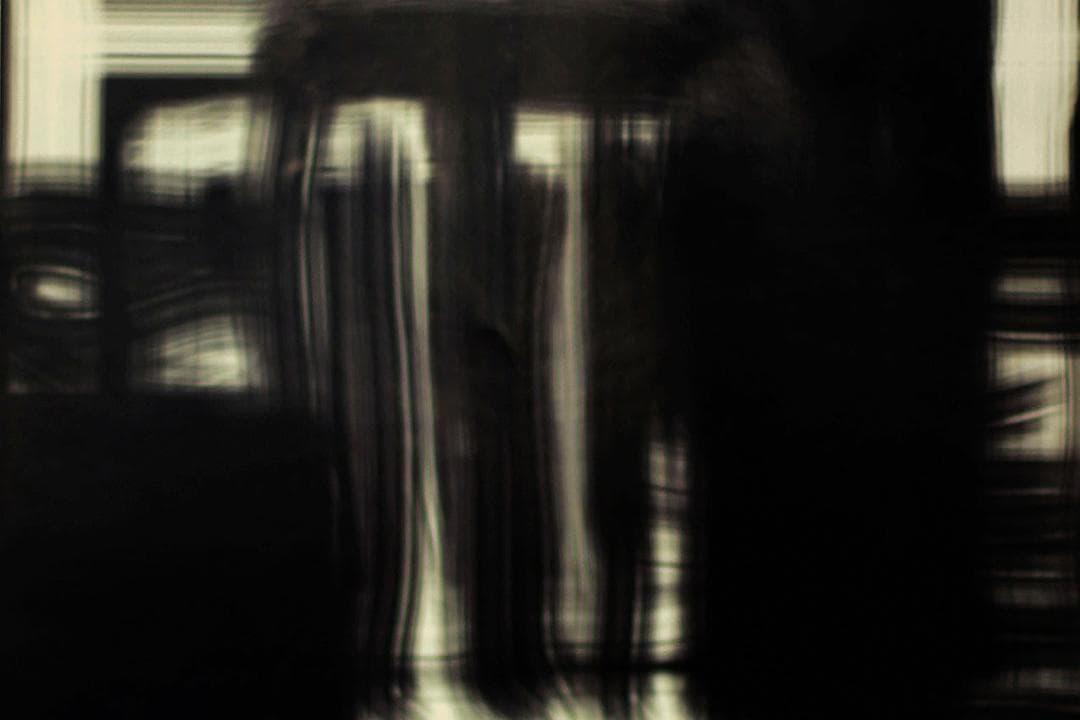
A Olho Nú
Pedro CalapezFrom the "Naked Eye" series (2012), 12 ink drawings were chosen that reveal parts of a nonsensical story, rectangles that follow one another in a hypothetical and schematic visual plan of a non-existent script. They personify the rapid flow of ideas, the dizzying flow of the drawing in which the represented is structured as the black lines run down the paper. The eye is naked because it cannot find protection from the visible.
The "small bodies" series, 2012/2013, sees the support as something transformable. The flat surface forgotten, the colors now undulate on a support with sinuous limits, deformations that seem to transport the immensity of colors they carry beyond the wall. These are paintings that manifestly transform into objects because they occupy the viewer's space, contradicting the conventional reading of the "painting".
"Conversation piece" and "frame" are part of the works in which I experiment with the different potentialities of image manipulation on the computer, but also on the iPad and iPhone, which materialize through digital printing on paper or other materials, in single or fragmented images.
Regarding gesture, I can affirm that the fragment is its catalyst element, and as Bresson tells us, the gesture may well be the dazzling and illuminating element that brings inner light to the composition, solidifying the multiplicity of readings, that is, fixing the act of making and providing the interrelation with all the other fragments that constitute the totality of the work. And the fragment, containing within itself the gesture, establishes the unforeseen path of the images.
But this gesture is not "gestural" but rather an element that explicates the difference between real space and the pictorial space experienced by the observer. These gestures are pure moments of painting and appear as marks that mix the aesthetic experience with the flow of the image. The gesture is the physical counterpart of the image, of what is represented, expanding the knowledge of visual space, and the apprehension of the space existing between the fragments.
The filling of the fragment's surface leads to the notion of accumulation, of the weight of color, visual but equally physical in the overlapping layers of paint. The weight of color also evokes the "behind," the depths of depths, what lies between the support and the surface of the painting. In the back of what is represented, I find a lightness. As if the colors had migrated from the interior of the support to the surface of the painting. What remains is a special void, a void filled with the absence of colors and lines. It is in this lightness that the time of the painting is also defined, for its space is revealed in a void, as Maria Zambrano refers to it: void: where there is neither weight nor resistance (distance to travel).